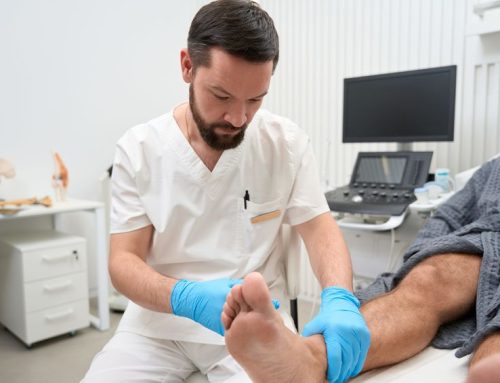
Bummed About Bunions?
A bunion is a common foot ailment called hallux valgus. This progressive bone disease creates a bony growth at the base of the big toe joint. As a result, the inner food displays a bony bump that slowly shifts the big toe inward toward the second toe. Common bunion symptoms include a protrusion at the big toe joint, swelling, redness, soreness, and limited movement. Wearing specific shoes can feel painful, and individuals can feel self-conscious. Severe bunions need a surgical procedure. Doctors today can help patients with minimally invasive bunionectomy, which has a host of benefits when attempting to restore the toe’s natural anatomy.

Causes of bunions
Bunions are very common, with 1 in 5 older adults forming this growth at some point. The condition is more likely to affect women than men, with 4 times the number of women having bunions than men. Along with women being more likely to develop bunions, factors like genetics, arthritis, foot injuries, and foot type all play a role. Wearing tight or high-heeled shoes, more common in women, is a risk factor. Bunions develop over several years, with many people ignoring the issue until severe consequences arise. While some conservative treatments can help, minimally invasive bunionectomy may be necessary for long-term improvement.
It’s time for a bunionectomy
Minimally invasive bunionectomy corrects the issue using multiple small incisions of an inch or less. This is unlike the large incision along the toe that is used in traditional open surgery. During the procedure, the surgeon will use the best strategies to remove damage and restore the toe’s natural alignment. The surgeon may use the Percutaneous Chevron Akin (PECA) technique, where the bones are cut and realigned. The surgeon removes bone spurs and other disruptions. Another technique may involve removing bone and fusing the joint to correct the deformity. The procedure is ideal for those with moderate to severe bunions, but who do not have arthritis or severe degeneration.
The power of minimally invasive
Minimally invasive bunionectomy uses small incisions and a scope device to view the bunion. The camera at the end of the scope projects the joint on an external monitor. Additional small incisions the size of buttonholes are then used to complete the procedure. Minimally invasive surgery is well known to reduce recovery time while causing smaller scars and less postoperative pain. Small incisions also mean less blood loss and fewer complications, like infections. As the procedure is quick and needs limited incisions, patients can leave the surgical center the same day and begin recovery at home.
Take your bunions seriously
Bunions are often overlooked as a genetic trait or a natural part of life. If left untreated, bunion symptoms can increase, and limited mobility is possible. The condition costs time, limits social activities, and prevents patients from wearing certain shoes. Bunions, regardless of severity and genetics, are treatable. Minimally invasive surgery has proven to address the underlying cause, helping to realign the bone and reduce pain. The small incisions mean patients improve the structure while still maintaining the cosmetic look of the foot. With a surgeon's guidance, correcting this issue quickly and enjoying a fast recovery is possible.